
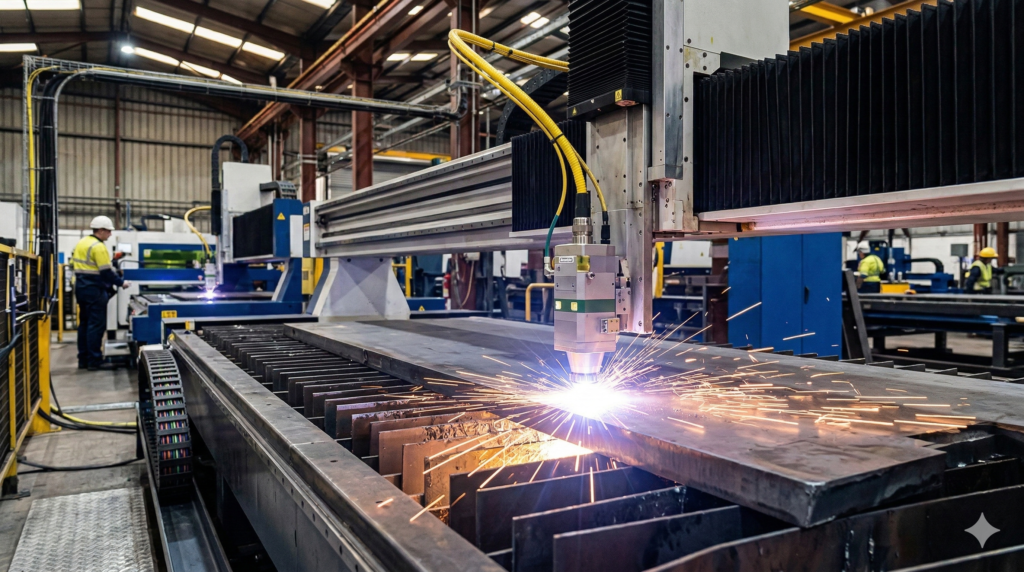

We briefly called out the industrial laser IDM (integrated device manufacturer) companies a few weeks ago in our deep dive on analog chips used in auto/industrial/power semiconductor applications (video linked above). With a coming uptick in U.S. manufacturing activity — possibly a longer cycle of growth led by AI data center construction — let’s circle back to those companies.
Industrial and fiber laser system manufacturers
The two specific companies we’re referring to are small semiconductor IDMs IPG Photonics (IPGP) and nLIGHT (LASR). These two and other industrial laser IDMs also compete with the larger more diversified Coherent (COHR) and Lumentum (LITE), which have been hot thanks to data center optical networking.
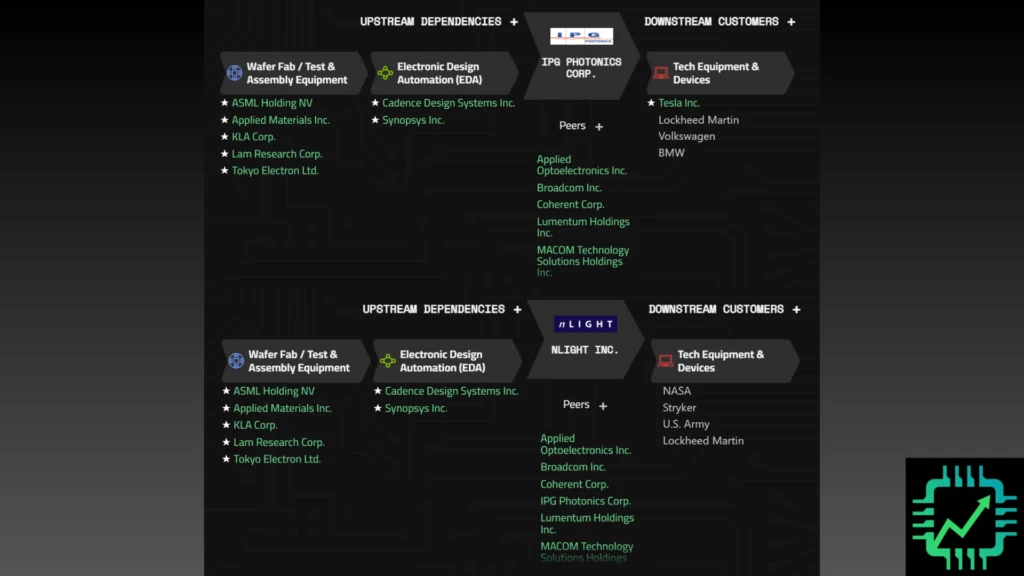
IPG and nLIGHT have been off to the races, especially so far in 2026 — and perhaps for a not-so-great reason. Besides numerous advanced manufacturing, medical, imaging and sensing, and other use cases, industrial lasers currently count aerospace & defense as a top end market. War in Iran isn’t coincidental with these stock prices going parabolic, nLIGHT in particular.

Need a financial analysis terminal and data visualization tool? Check out Fiscal.ai, and use our link to get 15% off any paid plan: Fiscal.ai/csi/
What is a high-energy fiber laser?
- LASER: Light Amplification by Stimulated Emission of Radiation
Aerospace & defense contractors use high-energy lasers (or HEL) for directed-energy infrared missile and drone defense systems. Think Lockheed Martin‘s (LMT) HELIOS or RTX Corp‘s (RTX, formerly Raytheon) HEL systems. HELs come in various forms, but fiber lasers in particular are often used in these defense applications.
How exactly does a fiber laser work? IPG provides a visual. Semiconductor devices called pump diodes — usually based on III-V semiconductor materials like gallium arsenide (GaAs) or indium phosphide (InP) — emit energy in the form of light when conducting electric current. Light from multiple pump diodes is collected and concentrated via a “gain medium.” In the case of a fiber laser, the gain medium is glass fibers that have been doped with rare-earth elements, manufactured into a special fiber optic cable, with highly reflective materials used to adjust and focus the final laser output.
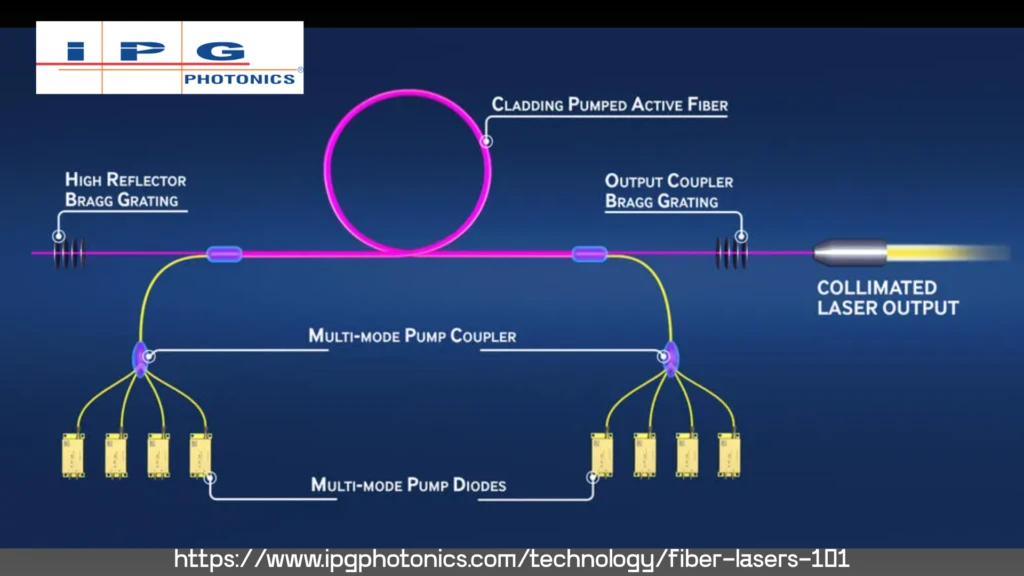
https://www.ipgphotonics.com/technology/fiber-lasers-101
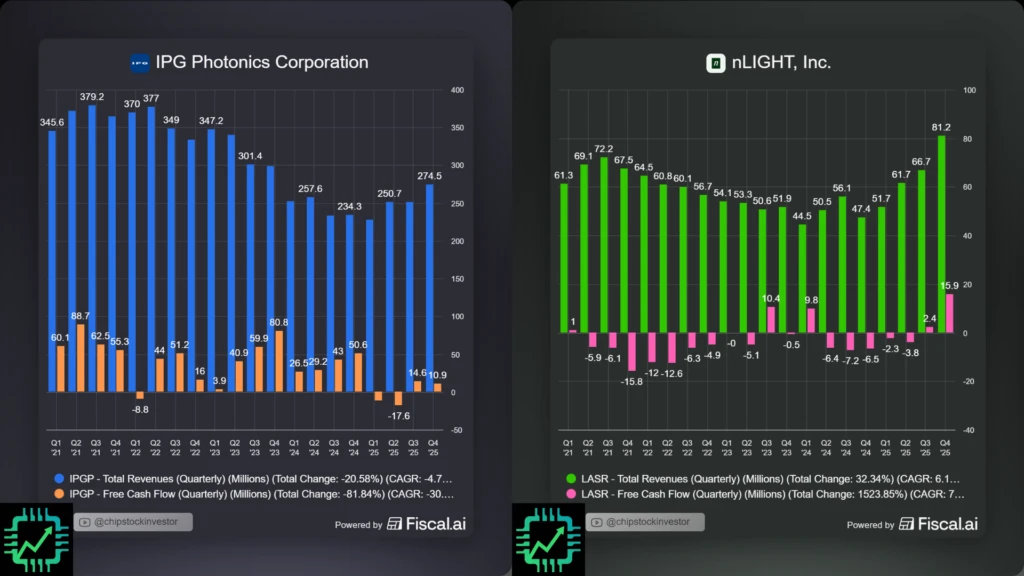
These HEL fiber lasers have been especially potent for nLIGHT this year. Customers in U.S. defense and military applications became the majority of revenue in 2025, sending sales to all-time-highs. Free cash flow profit also turned positive and hit new records in Q4 2025. Involvement with the U.S. Golden Dome missile defense project could help sustain growth this year and beyond, but nLIGHT management has said timing of these deals will be discussed when details are available.
IPG has also benefited from these defense applications, but it is much more diversified by end market, as well as by laser applications (low- and medium-energy lasers). IPG is still dealing with a multi-year downturn in these various industrial end markets that have hampered its profitability (free cash flows displayed below).
Will a manufacturing sector recovery benefit IPG and nLIGHT?
If manufacturing is in the early stages of recovery after a multi-year downturn, in the U.S. in particular, IPG Photonics and nLIGHT are poised to benefit. nLIGHT is much more the aerospace & defense momentum play, but IPG could still have much to gain if its end markets continue to inflect higher again.
And both companies are well capitalized, with plenty of cash on balance. IPG has no debt, and nLIGHT has very little meaningful debt on balance.

However, the recent run higher in both stocks — nLIGHT especially — already prices in some of that future expected recovery. For the more diversified IPG, a more robust return to profitability will need to accompany rising sales.
Join Semi Insider for more of the conversation, and upcoming CSI Live events and Q&A discussing these companies and more!
