
As we’ve been discussing the last month or so, first half 2026 was a “buy now, ask hard questions later” event for many semiconductor and related supply chain company stocks. July is now the time many investors have decided it’s time to ask some hard questions.
Corning (GLW) spent years as a quiet, steady industrial name that most growth investors ignored. That changed in the second half of 2025, when the stock got really popular and soared some 300% year-over-year through June 2026. Optical networking and glass substrates are to blame. It’s time to ask harder questions. Here is a brief look at the company and what changed.
A 175 year old materials company
Corning has been reinventing itself since it sold off its consumer cookware business, including CorningWare and Pyrex, back in 1998 to focus on technology grade glass, ceramics, and optical physics. Today the business is split into four main areas: Optical Communications, Glass Innovations, Automotive, and Solar, plus a minor segment for Life Sciences. We meet its wide range of products in everyday life, from Gorilla Glass on your phone to the fiber optic cable running into data centers to catalytic substrates in your car’s exhaust system.
For a long time, this was a slow growing, cyclical business, but things changed when the AI data center buildout arrived.
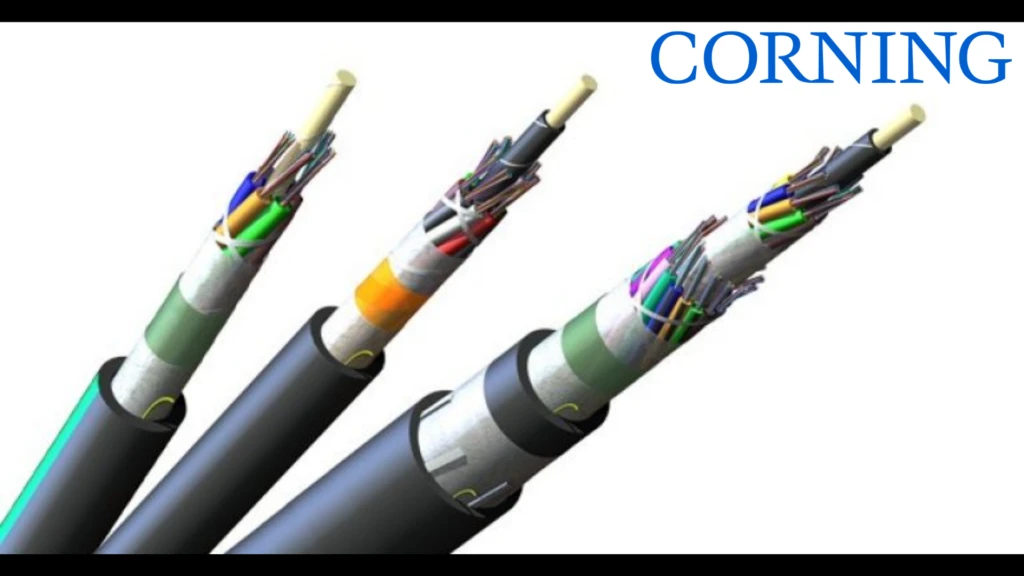
AI models run on physical hardware across the cloud and on-prem enterprise systems, so connecting thousands of GPUs in these data centers requires insane, lag-free speeds. Because traditional copper wiring simply can’t handle the distance, heat (loss of energy), and bandwidth of these workloads, the industry is slowly turning to a different solution: high-density optical fiber, what we like to call the modern long distance freeway of the AI data center.
Backed by the tech giants
A string of major customer commitments in the first half of 2026 pushed Corning’s growth story into the spotlight.
In January, Corning and Meta (META) announced a multiyear agreement worth up to $6 billion for Corning to supply the optical fiber, cable, and connectivity products powering Meta’s U.S. data center buildout. The deal included a new cable manufacturing facility in Hickory, North Carolina, projected to grow Corning’s North Carolina headcount by 15% to 20%.
In May, Corning and Nvidia (NVDA) announced a multiyear partnership to expand U.S.-based manufacturing of optical connectivity products for AI infrastructure. Corning plans to grow its U.S. optical connectivity capacity tenfold and expand fiber production capacity more than 50%, building three new plants in North Carolina and Texas and creating more than 3,000 jobs. Nvidia CEO Jensen Huang called it part of the largest infrastructure buildout of our time.
In June, Amazon (AMZN) signed a multiyear, multibillion dollar agreement for optical fiber, cable, and connectivity solutions to power AWS data centers. Its respective announcement said it would be adding 1,000 advanced manufacturing jobs plus hundreds of construction jobs at Corning’s North Carolina facilities, along with a new fiber optic technician training program with Catawba Valley Community College.
Three of the largest AI infrastructure spenders in the world naming Corning as a manufacturing partner within a six month span gave investors a much more interesting growth story to evaluate. Put another way, Corning has become part of the U.S. manufacturing re-shoring story.
The Springboard plan
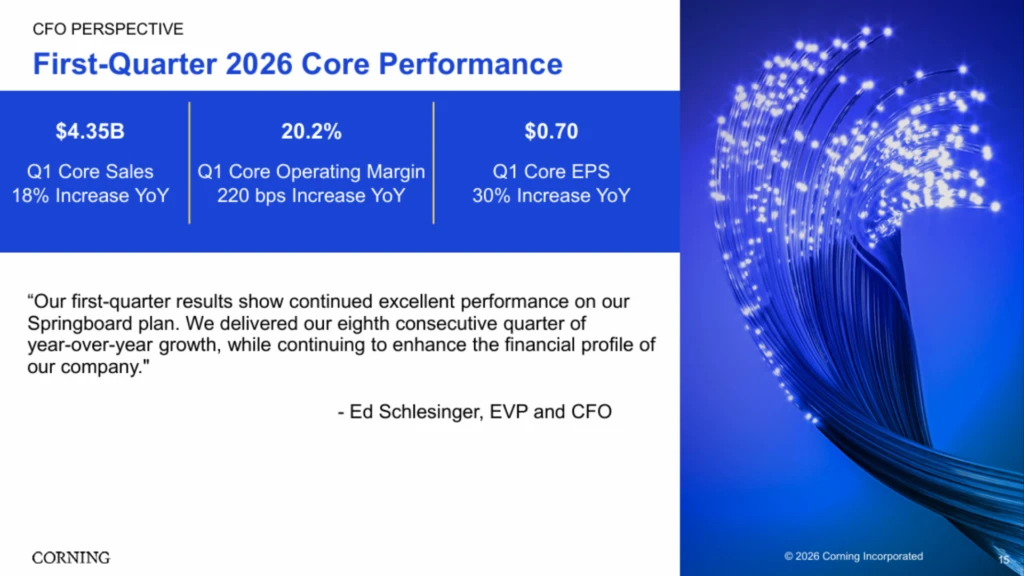
In the third quarter of 2023, Corning introduced its Springboard plan, a target to add $3 billion in incremental annualized sales and lift core operating margin to 20% by the end of 2026. Management hit both goals one year early, and results in 2025 and into 2026 show why the stock started moving. Full year 2025 sales came in at $15.6 billion, up from sales of $13.1 billion in 2024, while GAAP net income attributable jumped to $1.6 billion from just $506 million the year before.
The momentum has carried into 2026. First quarter net sales rose 20% year over year to $4.1 billion, led by a 36% jump in Optical Communications, with management citing strong demand for generative AI products and data center interconnect, as well as fiber to the home demand (internet infrastructure).
Alongside the new partnerships announced in the first half of 2026, Corning upgraded its Springboard targets. The company now expects to reach a $20 billion annualized sales run rate by the end of 2026, $30 billion by the end of 2028 (versus $27 billion before), and $40 billion by the end of 2030 (versus $35 billion). Management also introduced a new photonics platform with a goal of building it into a $10 billion revenue stream by 2030.
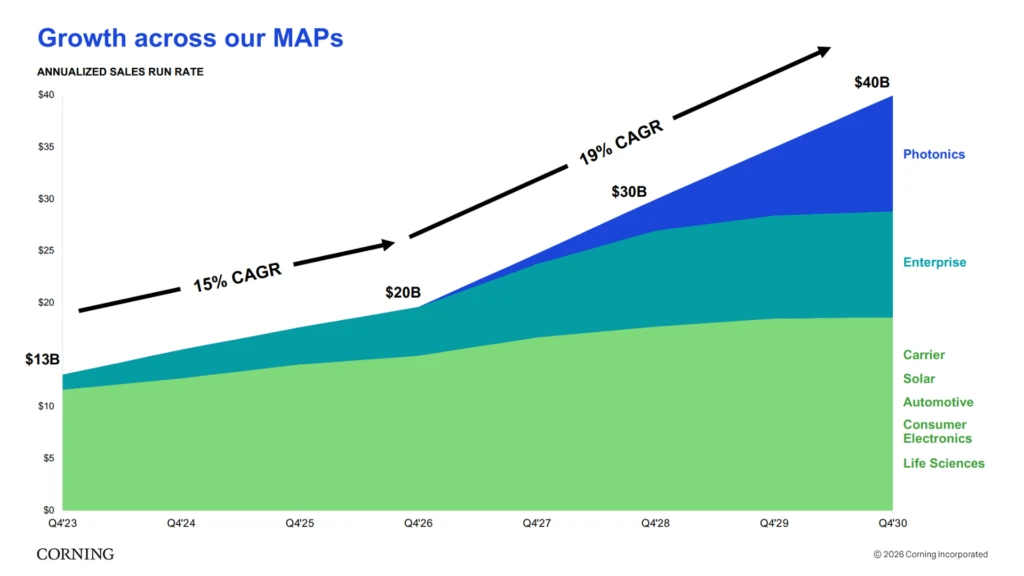
Notice the accelerating revenue expectation starting in 2027 through the end of 2030. That’s due to the new photonics platform, which is presently non-existent, for all intents and purposes.
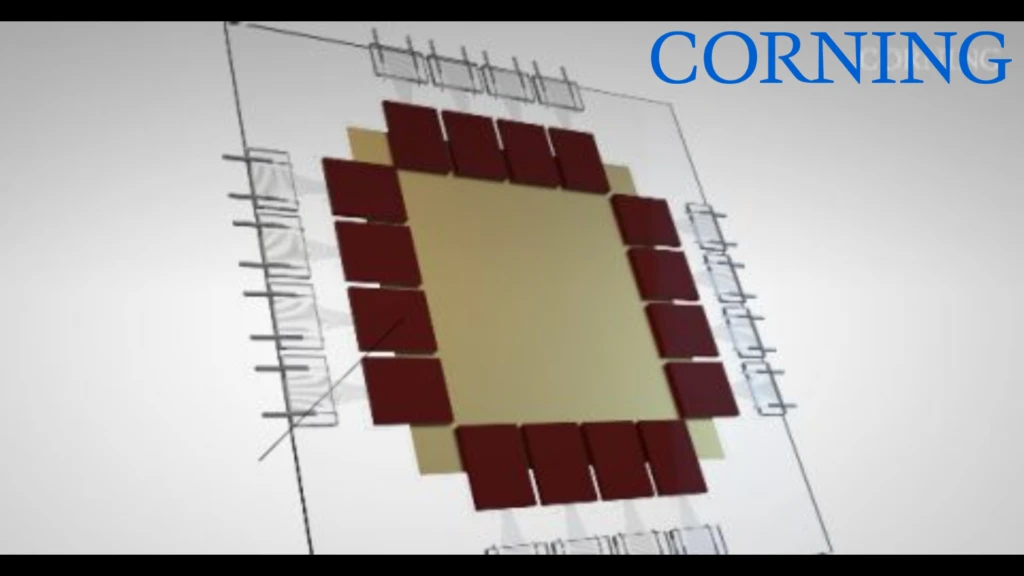
What is this new photonics platform? Optical connectivity is the headline story, but Corning has extended its know-how into glass substrate and advanced packaging (see picture below for an AI processor/XPU). This emerging technology for next generation chip packaging could extend the company’s relevance in semiconductors well beyond fiber and connectors. Estimates point to these new advanced substrates going into full production within the next few years.
Is Corning the ultimate AI play, or is it running too hot?
Multi-billion-dollar backlogs with Meta, AWS, and NVIDIA are real and Corning is certainly having a moment in optical networking. But we can’t ignore Corning’s historical and present cyclicality – specifically, short cycles that kept a lid on a higher valuation multiple. Historically, this is a slow-moving manufacturer of basic materials (glass), operating at a single-digit % profit margin.
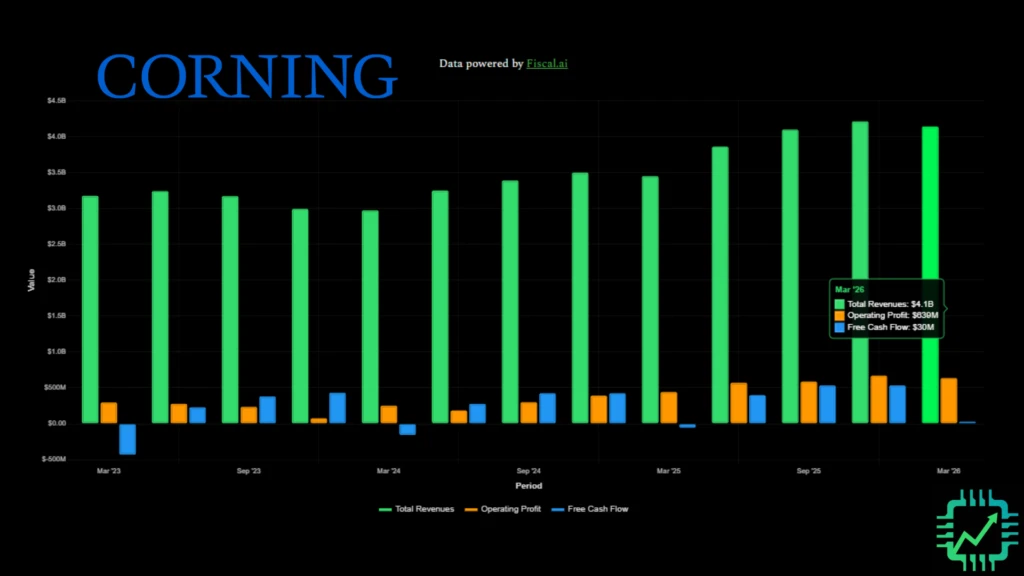
Manufacturing demand ebbs and flows, competition is intense across every business segment, and a meaningful piece of the new growth story depends on continued heavy capital spending from a small number of large customers. If AI data center buildout plans slow, Corning’s longer-term growth assumptions could come into question.
We ran a few reverse DCF (discounted cash flow) calculations to judge what the market is pricing into the stock price now ($170 to $180 per share after a sizable pullback in recent weeks). We came up with the following scenario:
- Started with trailing-12-month EPS (old mature business) of $2.09
- Average EPS growth rate of 46% for 5 years (through the end of the new 2030 Springboard plan)
- Terminal rate of 4%
- Discount rate of 10%
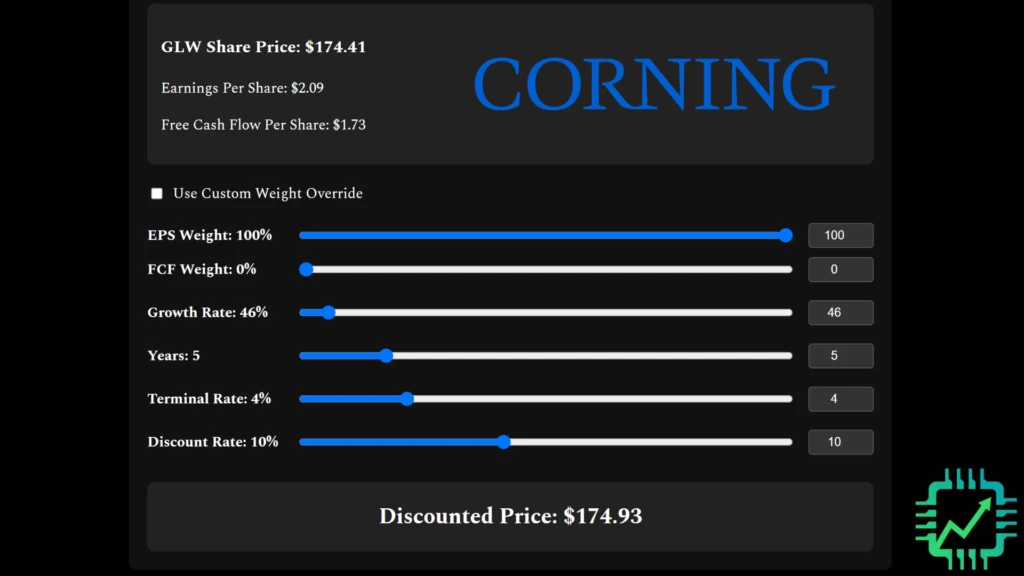
An average of 46% EPS growth in each of the next 5 years is a pretty high bar to clear. Granted, to kick off 2026, Corning’s EPS nearly doubled from a year ago thanks to higher sales and a big increase in profit margin thanks to new optical cable and other products. Glass substrates, once they start contributing in 3 to 5 years, could help sustain that rate.
Nevertheless, for an old manufacturer with a significant amount of mature business lines (consumer, industrial, etc.), we were curious what stock price would assume a far more modest 30% average per year growth rate (but still pretty high!). At 30% per year, that’s more in-line with Corning’s forecasted 19% average revenue growth rate starting in 2027, and leaves room for more profit margin expansion. We came up with the following:
- Same starting point of $2.09 EPS
- 30% EPS growth rate for 5 years
- Same terminal and discount rates of 4% and 10%, respectively
- Resulting stock price = ~$100
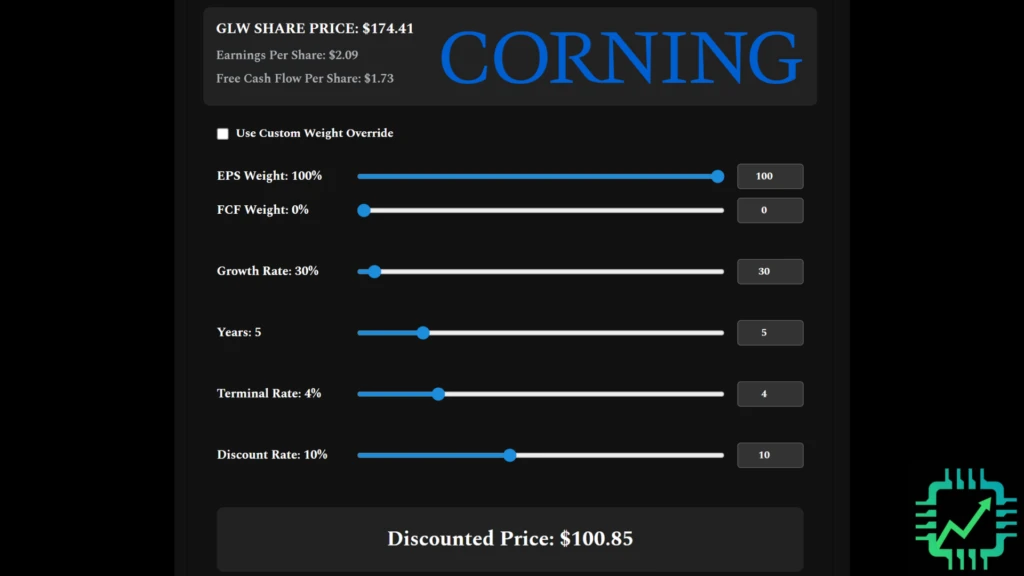
Now available in CSI Research Dashboard: Reverse DCF price alerts, like the one we set up in the above scenario. Add some data to your trade targets! Sign up here: chipstockinvestor.com/pricing/
To be clear, a 5-year 30% CAGR for EPS would be no joke! But in our above scenarios, a market re-pricing to this lower growth rate would require a roughly 40% drop in stock price. We’re not predicting GLW stock will tank another 40% from this point, but if it did, we’d want to do a follow to know why. And depending on the why, maybe we’d be more interested in buying at that time.
Bottom line
Corning went from an overlooked industrial stock to one of 2026’s most talked about AI infrastructure plays because its underlying Springboard turnaround got boosted with a run of landmark manufacturing partnerships, all within a six month window. The next few years of execution against higher expectations will determine whether this moment turns into a durable new chapter for the company. For now, we’ve decided we’re sitting it out.
