
This article was originally published on Chip Stock Investor Semi Insider on July 3, 2024.
As we’ve all been made very aware, we are in the midst of another step-change in software: AI.
Whenever there has been a technological breakthrough in the past, new winners have joined in the party and built economic empires. IBM was one of the originals with its mainframes and related software. Microsoft emerged as the leader in the PC era. Google gobbled up the internet, and later when it went mobile, Apple and Google gobbled up the market. Amazon helped pioneer the cloud, and AWS is still the leader. And now with AI, Nvidia‘s hardware and enterprise software is leading the charge.
The key to success for these businesses in each of these step-changes has involved a mix of hardware and software, as we often talk about. But it’s more than that. These “tech giants” have created massive incentive for developers to move to their platform — the bait being a large user base.
All of the tech giants, to some extent, have been able to fully integrate, and thus get a massive developer community to onboard into their “walled garden.”
Side point, we believe Meta is attempting to emulate this success with AI (and its “metaverse” Reality Labs business segment). Meta has the massive user base and one of the world’s most extensive ad and marketing ecosystems, but what it has lacked were extensive third-party developers enhancing the value of its walled garden. Here’s what we’ve written on that topic over the last couple years.
What’s all this to do with software, and especially investing in software companies?
A couple of members shared on Discord about how AI is changing the game for software developers. Funny thing that (most) software devs have never quite figured out is, they are almost always operating at a structural disadvantage. As we often say here, THERE ARE NO ECONOMIC MOATS in software. Only fastest cars.
In other words, a software developer, unless they have very broad breadth and depth to their portfolio, or have integrated infrastructure (cloud platforms), are always going to be at the whim of tech giants and whatever new tech breakthrough changes the game. It was no different when PC, mobile, and cloud computing came along. AI is no different.
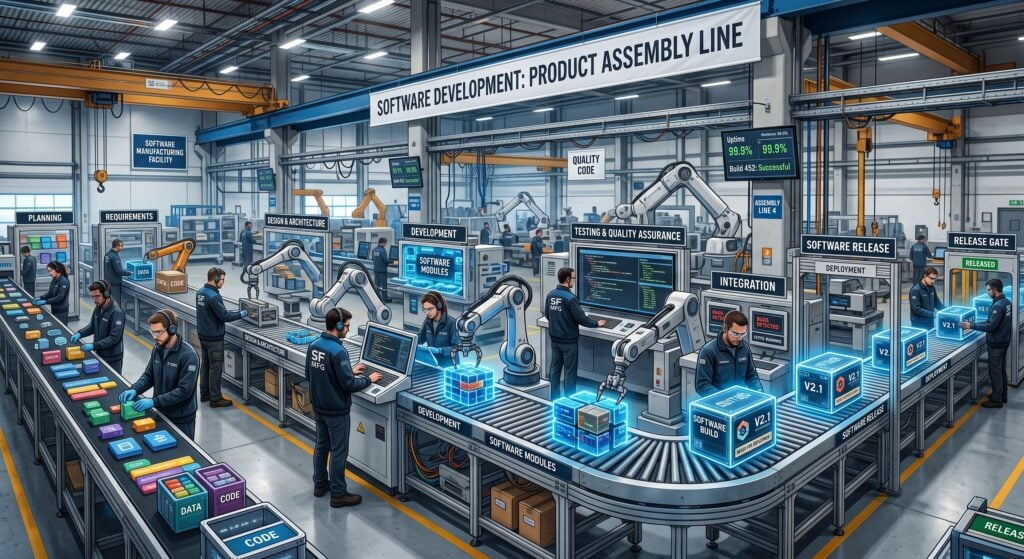
To frame this from just one more angle — and we’d argue, the most important angle if you’re an investor — it’s high time we simply start to think of software as just another manufactured product. (Yes, software can be technology too, but large parts of the industry isn’t.)
Using an “old economy” industry as an example
We like car analogies here at CSI, so let’s use the auto industry as an example. What are the basic ingredients needed to start an automaking business?
- An engineering team to design a vehicle (and, most preferably, an engineering team that works seamlessly with a marketing team)
- Construct a manufacturing line for the vehicle, and hire workers to manage that manufacturing line
- A pipeline of suppliers to fill in the parts you can’t cost effectively make yourselfSales and distribution channels that sell (and later help service) the vehicles to customers
- A pipeline of self-improvement and new feature addition so that more vehicles can be sold, and existing customers later come back and buy again (or continue to lease)
If you have experience in software, especially managing from a high level, you’ll immediately know that this structure is exactly the same as any other manufactured product, like autos. Yes, it’s tech, but most software anymore is less tech, and more utilizing existing pieces that have been developed and perfected over the course of decades.
For the non-devs out there, here are just three recent developments of especially the last decade, that have helped further “commoditize” software development.
- Software code repositories like Microsoft’s GitHub and GitLab, making it easier to manage the overall life cycle of the software (the product): https://aws.amazon.com/what-is/repo/
- Containers, with Google’s open source Kubernetes, reducing software deployment into easier to manage, deploy, and secure packages (like a parcel traveling through a postal service): https://cloud.google.com/containers?hl=en https://cloud.google.com/learn/what-is-kubernetes
- APIs (application programming interface), acting like a “parts supplier,” because why make something new in-house if a third-party can do it cheaper?
Nvidia and the new AI companies it has helped spawn (including OpenAI) are taking this concept further, which is why so many enterprise software companies have been able to quickly embed AI chatbots into their products in the last year or so: https://aws.amazon.com/what-is/api/ https://www.nvidia.com/en-us/ai/
In short, these challenges (which are not new) is why we think most software stocks can simply be owned via an index fund. They’re operating at a disadvantage, and most always will.
What are the traits a software company can possess, or develop, to stand out as superior? Let’s go back to the automaker example to create a mental framework.
1. An engineering team with a seamless marketing team
Great cars don’t just happen. They’re designed with a purpose, to appeal to a certain demographic, and all aspects of the product are engineered to that goal. Software is no different. A company can carve out a powerful niche by doing the same thing: Solve a specific problem, get all the fine details just right, and then hit those prospective customers hard with marketing that accentuates those features. Of course, to make this process sustainable, a software company will need to do all of this profitably.
2. The manufacturing line
To reach sustainability (profitability), a software company will need to be efficient in its development. There will need to be some sort of in-house proprietary production (remember, it’s really hard to patent software) or technological invention, and it will need to be pulled off so that profitable scale can be reached ASAP. The proper scale at which a company reaches profitability often coincides with the overall size of the addressable market (let’s arbitrarily call it 10% of addressable market).
3. A pipeline of parts suppliers
This is where APIs come into play. We’re already seeing this play out in AI. And if we decide to invest in the parts supplier itself (the company trying to monetize via API or some other sort of supply chain or infrastructure product), the company needs to demonstrate the right level of attention to tech invention and economic viability (it’s not just the absolute best tech that wins, it’s the best tech with the right business model).
4. Sales and distribution channels are where things get really difficult for software manufacturers
Currently, thanks to mobile, cloud, and now AI, distribution has been concentrated into the hands of the walled gardens (Apple, Google, Microsoft, AWS, maybe Oracle now too). They also control many of the tools that developers need on the “manufacturing floor,” which helps the walled gardens funnel product distribution through their channels.
At some point in the future, my hope is that as cost of computing comes down and the market fragments again (edge computing, see the thread on Akamai: https://chipstockinvestor.com/research-page/dont-think-about-investing-in-cloudflare-until-you-know-about-this-data-center-stock-net-stock/) software manufacturers with enough breadth and depth can take back a bit of control of their sales and distribution.
Until that time, this is why the tech giants really ought to be core positions in any portfolio. They simple control the pulse of the IT sector.
On this point, we think the power of the tech giants is very simply (and unintentionally) illustrated by Google in this graphic.
5. Continuous improvement and feature additions are easier than ever, thanks to the SaaS model
But a natural part of this is also increasing breadth and depth of a software product portfolio over time (ownership of some compute infrastructure, enough depth it can control many of its customer relationships and distribution). To pull off this continuous improvement, this is why a strong balance sheet (ideally, more cash than debt) and self-sufficiency (especially free cash flow) need to be paired with a focused management team with an ability to execute on production and go-to-market.
Final thoughts and investing take-aways
This is why — perhaps frustratingly for you if you’re looking for “the next big thing in IT,” but also for us too as the current state of tech doesn’t match our preferred vision of what it should look like — you’ll often hear us talk about scaling into a smaller businesses in small chunks, and gradually over time. Unfortunately, most software companies (and many chip stocks too) lack or are deficient in one or all of the five key “manufacturing” characteristics described above. Only the big walled gardens possess all of the traits that make them relatively “safe” (lower probability of permanent loss of capital) growth stocks.
For the rest of the companies in software, it really is time we start assessing them much as we would any other company that manufactures a product. It can help thin out the field of prospective investment options, and whittle down our focus to the select handful that deserve more attention.
Join us on Semi Insider for more on the conversation, and for access to our growing set of investor tools to manage portfolios and analyze businesses.

One Response
Political or geopolitical risk?