


A lot has happened in the quantum computing R&D startup industry since the start of 2025 — culminating in the U.S. Department of Commerce announcing $2 billion-worth in investments in various quantum computing companies on May 21, 2026.
We’ll come back to those investments in a moment, but how did we get here? Let’s run through the investor highlights.
A brief timeline since the start of 2025
- January 2025: Nvidia CEO Jensen Huang doused the quantum industry with frigid water, stating that very-useful practical quantum computing (hardware capable of solving real-world problems at a cost lower than classical data center computing) was likely “15 to 30 years away.”
- Publicly-traded quantum computing stocks took a beating. Ensuing geopolitical conflict and U.S. tariff announcements also did quite the number of speculative small-caps, quantum stocks included.
- March 2025: Nvidia GTC 2025 includes a special quantum day, in which Jensen walked back his previous comment. Nvidia PR likely reminded him that a top science R&D sales outlet for Nvidia is the nascent quantum computing industry.
- Jensen walked back those comments again and said quantum was nearing an “inflection point” in June 2025. Quantum stocks stay hot through mid-2025 as the market rallied.
- October 2025: Nearly a year after announcing its new Willow quantum chip, Alphabet‘s Google Quantum AI subsidiary publishes a peer-reviewed verifiable quantum advantage test using one of its algorithms, “Quantum Echoes.”
- While still not a real-world problem with practical application, the test can be repeated and verified by other quantum hardware and is incremental progress towards fault-tolerant quantum computing.
- January 2026: As quantum computing progresses towards commercial use, scaling up manufacturing now is a next crucial step. In line with this, IonQ (IONQ) announced the acquisition of small U.S. semiconductor foundry Skywater Technology.
- Skywater has a segment involved in quantum manufacturing R&D, with some small manufacturing capabilities already built and servicing startup customers like PsiQuantum, Silicon Quantum Computing, QuamCore, and D-Wave Quantum (QBTS).
- February-March 2026: Three new quantum computing companies debut on public markets via SPAC merger: Infleqtion (INFQ), Xanadu (XNDU), and Horizon Quantum (HQ).
- As is the case with the other publicly-traded quantum stocks, these companies earn minimal revenue and operate at a loss (“pre-commercial revenue”) from R&D projects, most of them with various government branches and entities.
- March 2026: Google announces a 2029 timeline to secure the internet with post-quantum cryptography (PQC). PQC are security algorithms that are resistant against large-scale quantum computer attacks.
- This is in response to rising concerns around “store now decrypt later” attacks in which malicious actors steal encrypted data with an intent to decrypt it with quantum computing in the future. About a week later, Cloudflare (NET) also announced its timeline to be post-quantum secure by 2029.
- May 2026: Honeywell‘s quantum computing startup segment, Quantinuum (QNT), also files for an IPO. Honeywell Automation (separation with Honeywell Aerospace will complete in June 2026) will remain the majority shareholder of Quantinuum after IPO.
- May 2026: U.S. Department of Commerce announces $2 billion in investments into the U.S. quantum computing industry.
- May 2026: Notably, a day after the U.S. Department of Commerce announcement, Nvidia’s NVentures venture capital segment announced a $100 million investment in France’s Alice & Bob quantum hardware startup.
- Alice & Bob is a partner in Nvidia’s NVQLink used to connect quantum processors with GPUs to build hybrid classical-quantum computing systems.
Where is the U.S. government cash going?
As stated a year-and-a-half ago in our write-ups (linked at start of article), as the future promise of economically viable quantum computers nears, the existing semiconductor and electronics manufacturing supply chain is going to be highly relevant. Technological progress does build upon existing infrastructure, after all.
Thus, the U.S. government is taking the approach of infusing cash into select U.S. companies, and getting a minority equity investment in return. The target for the cash is primarily around supporting quantum manufacturing.
The top two beneficiaries of the $2 billion awarded under the U.S. CHIPS Act (signed into law in 2022) are as follows:
- IBM: Still one of the world’s largest tech patent and IP portfolios, IBM operates its Research advanced semiconductor manufacturing facility in Albany, New York; and expanded its Quantum Data Center and research lab in and around Poughkeepsie, New York (between Albany and New York City) in 2024. IBM is receiving $1 billion of the U.S. award to establish quantum-ready semiconductor wafer fabrication line. IBM will establish a new quantum subsidiary with the investment proceeds.
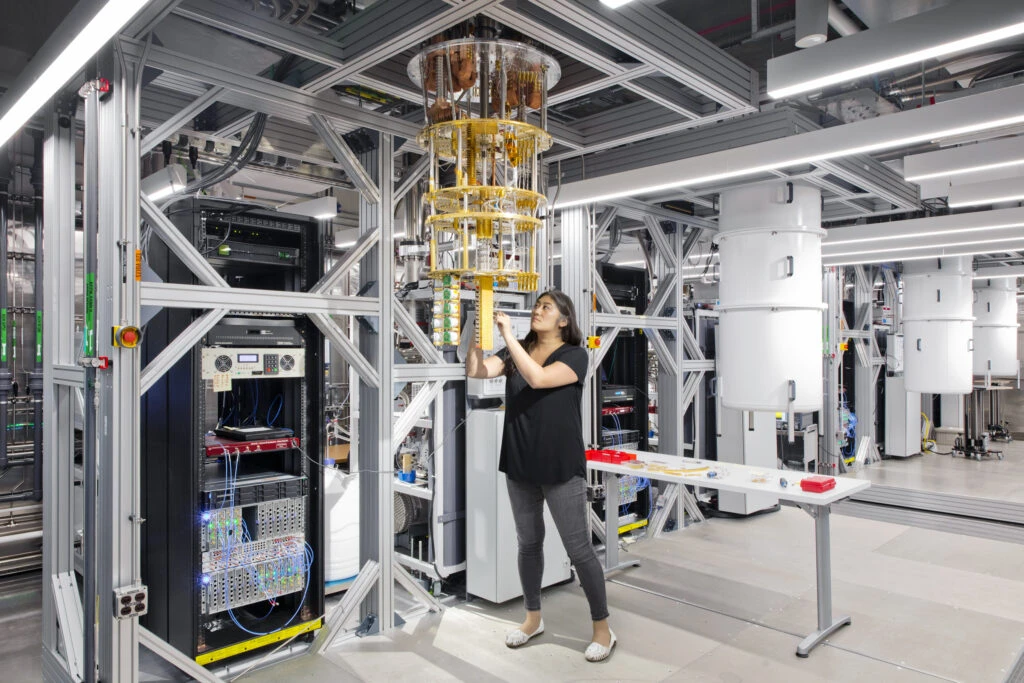
Image source: IBM.
- GlobalFoundries (GFS): A long-time partner with quantum startups, the U.S.’s largest semiconductor foundry will receive $375 million to bolster its quantum manufacturing capabilities across all quantum technology types.

Image source: GlobalFoundries.
As for the other awards for publicly-traded quantum companies, D-Wave Quantum (QBTS), Infleqtion (INFQ), and Honeywell’s Quantinuum (QNT) will each receive $100 million, and Rigetti Computing (RGTI) will receive up to $100 million. Private startups Atom Computing, Diraq, and PsiQuantum will also receive government funding in exchange for minority equity stakes.
The commonality across all these stated investments? Addressing “bottlenecks” in hardware manufacturing and integration challenges.
The takeaway for investors
As we’ve stated multiple times in the past, the best places for investors to focus attention right now is the existing semiconductor manufacturing supply chain — and especially the wafer fab and packaging equipment companies (ie. Applied Materials).
As for the quantum computing stocks, we’re still in watch-and-see mode. Early 2025 would have been a great buying opportunity. Given these businesses are still pre-commercial revenue stage, the stock prices and resulting valuation are highly volatile. We believe patience will yield a future opportunity. Stay tuned.
Join us on Semi Insider for more of the discussion, all of CSI’s research, and a growing set of tools to help investors cut through the noise and focus on what’s most important!
