On CSI Live this week, we were requested to revisit Ouster (OUST), a notable constituent in our “small bets” basket. It has been about a year since our initial deep dive. And while it remains a “prove-it” business, OUST’s recent Q1 2026 earnings and a technological breakthrough give us plenty of reasons to pay attention.
Here is where Ouster stands today, and why it remains a participant in the development of physical AI (self-driving cars and other vehicles, robotics, industrial equipment, etc.).
Transitioning to a move-fast AI business model
Ouster is successfully transitioning from a traditional integrated device manufacturer (IDM) to a predominantly fabless model. OUST maintains a small U.S. facility for minor in-house manufacturing, but they now rely on Fabrinet (FN) to manufacture their wafers and Benchmark Electronics (BHE) to handle assembly.
OUST Q1 2026 revenue came in at $49 million, up 49% year-over-year. The company’s multi-year goal was 30% to 50% revenue growth, we’re still moving right along as expected. Q2 guidance looks similarly strong, with a midpoint of $51 million expected and landing around mid- to high-40% YoY growth.
GAAP gross margin ticked higher to ~43%. As they lean harder into the fabless model, we expect this to scale toward 50% over time.
The important caveat, though, is Ouster is still operating at a loss. They are keeping their cash balance afloat by issuing new stock (issuing more shares, which you can see reflected in diluted shares outstanding, the pink line in the chart below). Thus OUST still has to prove it can cross the line to profitability and earn a larger spot in our portfolio. We’re content letting these things play out organically over the course of years.
Check out Semi Insider, we are building a new set of tools for investors to assess the new AI-powered economy. See all our research articles, get access to financial data from Fiscal.ai, and join us for our weekly live Q&A events!
The color LiDAR breakthrough for physical AI
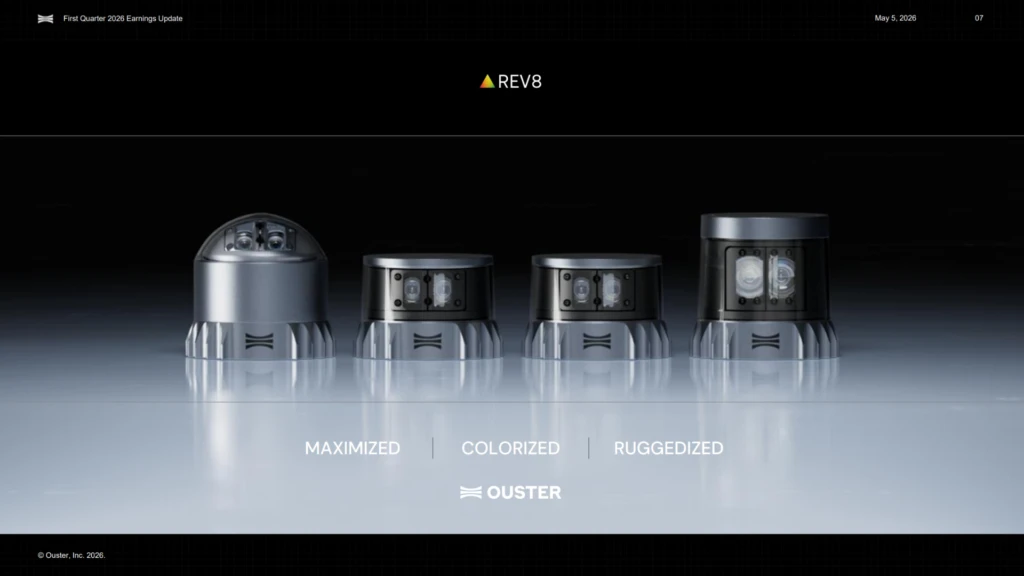
In recent weeks, Ouster has been talking up its latest technology: Native color LiDAR, introduced with their new Rev8 sensor family (powered by the L4 Max chip). Notice the image below. When you’ve seen LiDAR images before, it looks more like a heat map, sort of like from the alien in Predator.
In reality, LiDAR doesn’t have any native color, and it isn’t a heat map. Visualization software adds artificial color to make the 3D data mapping (or light intensity, measuring reflectivity of objects) collected from the sensor readable to us humans.
With some help from Fujifilm and its work in developing color filters for imaging, Ouster’s Rev8 sensors combine 3D imaging with color. For physical AI system developers, this could reduce multi-sensor complexity and the need for sensor fusion that combines LiDAR with imaging data.
Also of note, OUST’s biggest LiDAR rival Hesai also announced a color-native LiDAR family last month. So everything that follows can also be applied to Hesai as well. The race is on…
Imaging for physical AI sounds familiar, where have we heard this before?
A couple months ago, we did the video and write-up about Sony (SONY) and CMOS image sensors. Let’s compare OUST’s recent announcements with those notes:
LiDAR/Radar: For depth perception and temporal context (speed and timing).
CMOS image sensors (cameras): For high-definition 2D visual and color context; algorithms can be used to achieve depth (3D) mapping as well.
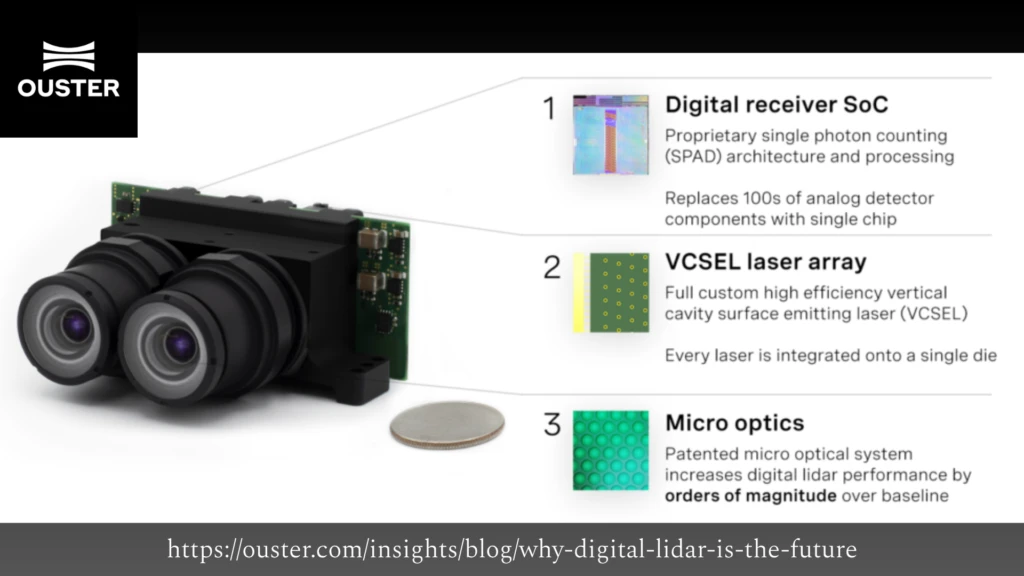
Notice the similarities in CMOS image sensor hardware with LiDAR below. There’s a lens, a color filter, a “receiver” chip that collects the incoming, and processor circuitry for the conversion of that data into a digital signal. We all use these on our phones when taking pictures and videos.
What’s the difference with LiDAR, and now LiDAR with native color (also making use of a color filter like CMOS image sensors)? The addition of a “transmitter” chip, specifically a VCSEL laser array. This is how LiDAR is able to get accurate depth and temporal readings. It’s actively sending out light as a signal, and reading that signal as the light reflects off the world around the physical AI system and returns to the sensor. (Some LiDAR sensors have a fixed field of view, others sit inside a rotating device, like on top of a Waymo taxi, to create a 360-degree field of view.)
Physical AI system builders often fuse together different data streams from multiple sensors. But this requires extra semiconductor content and software, which increases system complexity and drives up cost. Ouster believes combining color into LiDAR can reduce this complexity for developers that need the spatial and temporal power of LiDAR, but also some basic visual spectrum of light capabilities too.
Note that the resulting LiDAR imagery is still pixelated, especially compared to a high-definition camera. Improving the fidelity of this color-native 3D data will no doubt be a top area of work for Ouster now that the Rev8 sensors have made their debut.
Basic economics of LiDAR vs. CMOS image sensors
Color LiDAR could eventually be a big breakthrough for Ouster and help increase the total addressable market (TAM) for LiDAR. But “cheapest good-enough” technology tends to win the majority market share in the hardware market. Actually, this is usually the case in all industries.
CMOS Image Sensors: Cheap, highly scalable, and excellent at rendering 2D images, with nifty software algos to get more complex depth and temporal data. And because they’re so cheap, 360-degree field of view can be achieved by just adding more sensors to the system and fusing the resulting data — no spinning device needed.
LiDAR Systems: LiDAR is both a transmitter and a receiver. It utilizes a VCSEL laser array to send and receive light into the environment, measuring depth and velocity accurately (also using a CMOS image sensor). A single sensor on a spinning device can achieve 360-degree view, but the addition of that laser array emitter drives up cost.
Is this another case of cool tech running face-first into the economic reality wall? Perhaps.
The new Rev8 family is rolling out in several form factors, and customers spanning transportation tech to robotics are experimenting with the resulting higher-context data. Ouster is qualified for use in Nvidia‘s DRIVE Hyperion platform, and OUST said early adopters include Volvo, Google, and Field AI, among others.
By continuously shrinking the hardware, driving down unit costs, and adding crucial features like color context, Ouster is steadily expanding its total addressable market. High risk, potentially high reward, but enough progress we’re happy to keep tabs on the development.
Nicholas Rossolillo has been investing in individual stocks since 2005. He started a Registered Investment Advisor firm, Concinnus Financial in 2014 and was a contributor for The Motley Fool from 2015-2024.
Nicholas Rossolillo has been investing in individual stocks since 2005. He started a Registered Investment Advisor firm, Concinnus Financial in 2014 and was a contributor for The Motley Fool from 2015-2024.