
Since 2020, one of our favorite macroeconomic data points comes from the U.S. Census Bureau, specifically its monthly new business formation statistics press release. The data for July 2026 will be out on Wednesday August 12, you can find it here: https://www.census.gov/econ/bfs/index.html
Here’s the high-level numbers for June 2026, and the updated trend chart. Take a look at that massive jump in new business formation applications the second half of 2020, which has resulted in a permanent step-up in business formation activity — especially “non-high-propensity businesses” shown in the gray area chart.
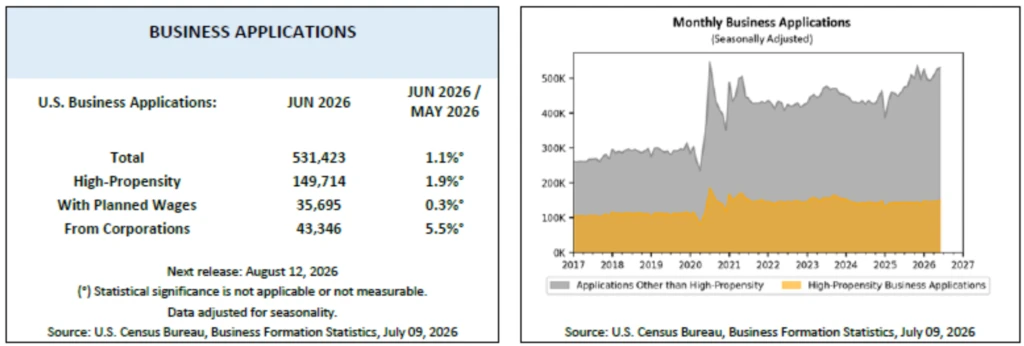
A high-propensity business is classified by the Census Bureau as one with a high probability of becoming a full business with employees and payroll. A non-high propensity business would be those not likely to generate payroll. Think proprietorships, partnerships, LLCs and other holding companies owned by one or just a few owners.
In other words, it’s a measure of increasing entrepreneurship, beyond economic sectors where employees and payroll are a higher guarantee (like manufacturing or healthcare, for example).
In the past, we’ve associated the above data with the boom in consulting and short-term freelance work that happened early in the pandemic (the “gig economy”); as well as in e-commerce activity, like that powered by Shopify (SHOP) — which had an excellent Q2 2026 report, by the way. https://shopifyinvestors.gcs-web.com/static-files/d47589d4-20d8-4612-b6e8-1dafa745f3c7
But now, thanks to the AI infrastructure race kicked off by OpenAI and Nvidia four years ago, software development falls into this category too. A couple years ago, we wrote about the coming changes: It’s Time to Think of Software, Not As Technology, but As Any Other Manufactured Product
The similarities in the U.S. Census Bureau chart above and this one shared by VYS (aka. Gregory Kennedy) last week are hard to ignore. The uptick in non-high-propensity business formation in 2025 and 2026 corresponds with a flood of new apps, software, and AI products.
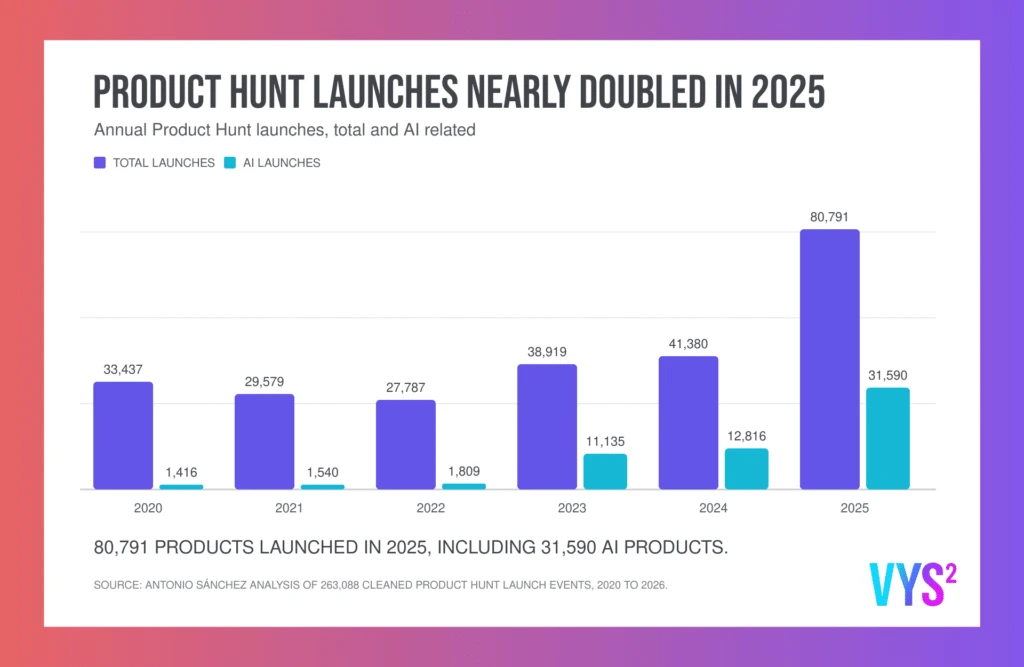
By the way, this isn’t a solicitation, we have no economic interest in VYS. As aspiring software and service company founders that have entered the software battle arena, we like reading Mr. Kennedy’s newsletter and thought the above data was worthy of call-out for this research note. https://vibeyoursaas.beehiiv.com/
Anyways, what does it mean? Since the severe supply chain and social disruptions of 2020, waves of economic activity have been working their way through the economy, like viral content working its way through a social network. A type of “bullwhip effect” on steroids, the pre-existing software and SaaS industry of 2026 has been the latest casualty as a massive number of new competition has entered the market, and AI tools enable more companies to build their own software rather than rely on an external vendor.
The good news is, at least from an investment perspective, most of these software and AI startups will fulfill the Census Bureau’s prediction and never become a “real” business with payroll. The explosion in software looks compelling, but a large majority of these projects have few to no users.
Put another way, the “productivity” hasn’t hit the software/application layer of the economy as much as it has the hyperscalers and neo-clouds that support these AI software startups, as well as their semiconductor and electronic equipment suppliers.
As with other viral industry booms, eventually there’s a bust, leaving the survivors to enter a new stage of higher productivity — and thus making them good long-term investment candidates. After the crazy market action of 2021, its been a very long “trough” for the software industry, with so far only select players emerging with a clear-cut “enlightenment and productivity” period (like cybersecurity platforms, as one example).
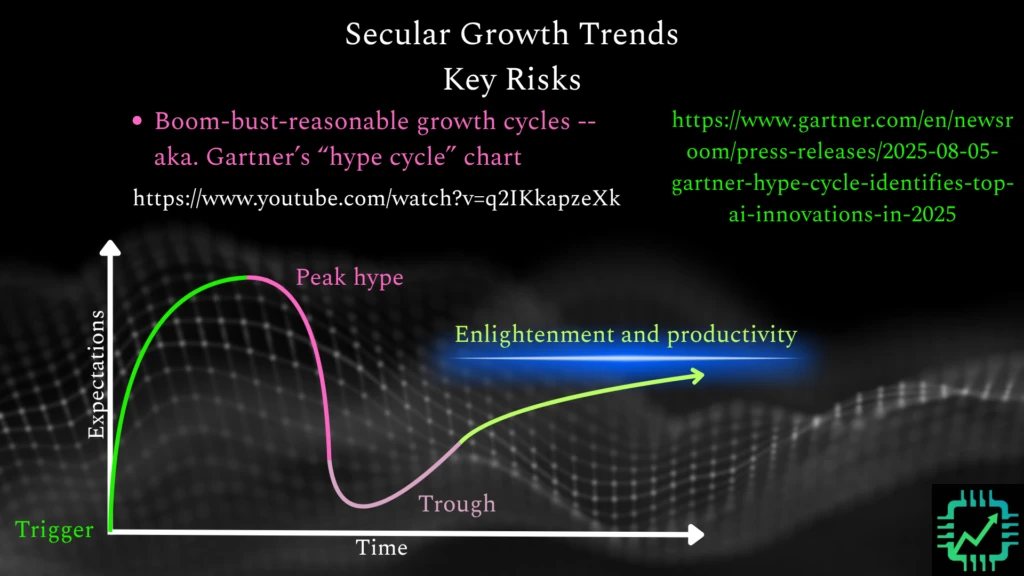
In short, it’s been another rough year for many of the end market software companies that purchase semiconductors and electronic equipment. But these investments aren’t dead. Survivors with vision, and strong balance sheets, change with the times. And a new wave of applications and companies with embedded software as part of their operation are being formed.
The AI semiconductor boom is laying the foundation for the next leg of this bull market, and an entirely new bull market of the 2030s. We fully intend to pinpoint what it will be, allocate to positions accordingly before the market figures them out, and riding the next wave. Thank you for being part of the journey with us, especially as we ready for the re-launch of our Research Dashboard in a few weeks!
–the CSI team–
